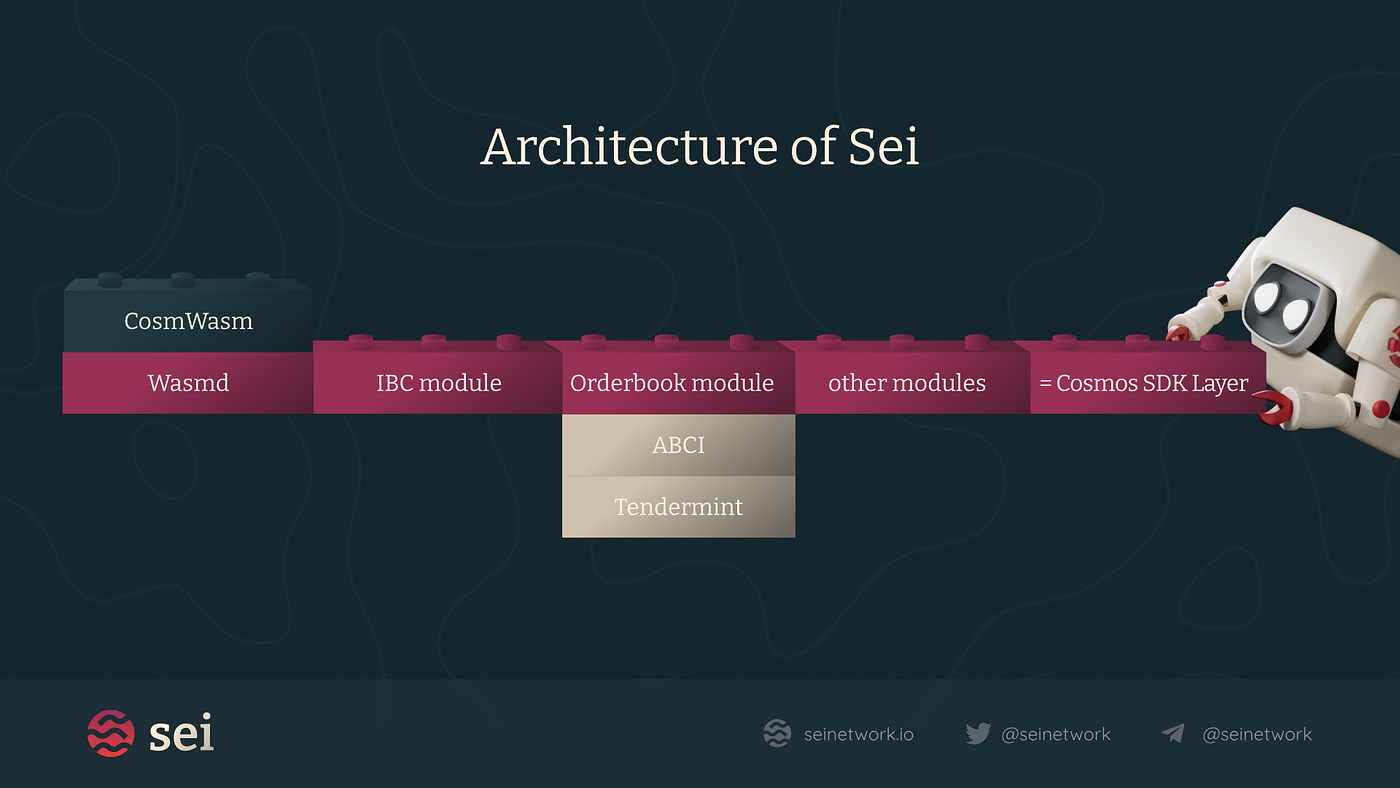
Sei Network is the first L1 blockchain focused on the order book. It is built using the Cosmos SDK and the Tendermint core and has a built-in central limit order book (CLOB) module. Sei-based dapps can be built on top of CLOB, and other Cosmos-based blockchains can use CLOB Sei as a shared liquidity hub and create markets for any asset.
Cosmos is an ecosystem of networks and tools that aims to provide interoperability. The main chain of Cosmos is the Cosmos Hub, which acts as a central ledger for interoperable blockchains called zones. Each zone is created in accordance with the needs of the developer and the ability to set their own cryptocurrency, set up block validation, etc.
Zones are created using the Cosmos SDK tool, which provides the necessary foundation for blockchain development in the Cosmos ecosystem. The Cosmos SDK uses the Tendermint Core consensus algorithm by default, which is supported by a certain number of validators. How a regular network member becomes a validator depends on the developers.
Sei total liquidity model
Designed with developers and users in mind, Sei serves as the infrastructure and shared liquidity hub for the next generation of DeFi. Applications can easily connect to trade on Sei’s order book infrastructure and access pooled liquidity from other applications. To prioritize the developer experience, Sei Network has integrated the wasmd module to support CosmWasm smart contracts.
CosmWasm: History
But modules have also been developed on the Cosmos SDK that allows you to write contracts in Rust. One of these modules is CosmWasm. It includes the Web Assembly virtual machine. Smart contracts on CosmWasm have advantages and disadvantages. Blockchains can be written using the Cosmos SDK and Ignite. Let’s take a browser example. You can write a browser, but smart contracts are like scripting. That is, by analogy, you can write your own browser and it will work according to any rules.
Not all browsers need scripts. Some blockchains do not support smart contracts and CosmWasm, simply because they are not needed there. For example, there is no CosmWasm on Crescent. On Juno, anyone can create a smart contract and send it, on Osmosis permissionless smart contracts, there is a whitelist of contracts that will be uploaded. There is also an EVM module on Evmos, it allows you to write contracts on Solidity.
Why Sei?
Sei is a level 1 blockchain specifically built for the order book. The network focuses primarily on reliability, security, and high throughput, creating a whole new echelon of super-high-performance DeFi products built on top. Sei’s network CLOB and the matching engine provide deep liquidity and price-time priority matching for traders and applications. Applications built on top of Sei benefit from built-in order book infrastructure, high liquidity, and a fully decentralized matching service. Users benefit from this exchange model with the ability to choose the price, size, and direction of their trades, combined with MEV protection.
Smart contracts
Sei uses the wasmd module to allow developers to easily create Sei. Developers can use the Rust-based CosmWasm library to build decentralized applications. This gives developers many benefits:
DEX module
Sei has created a new dex module that allows Cosmwasm smart contracts to use the underlying CLOB to provide high liquidity.